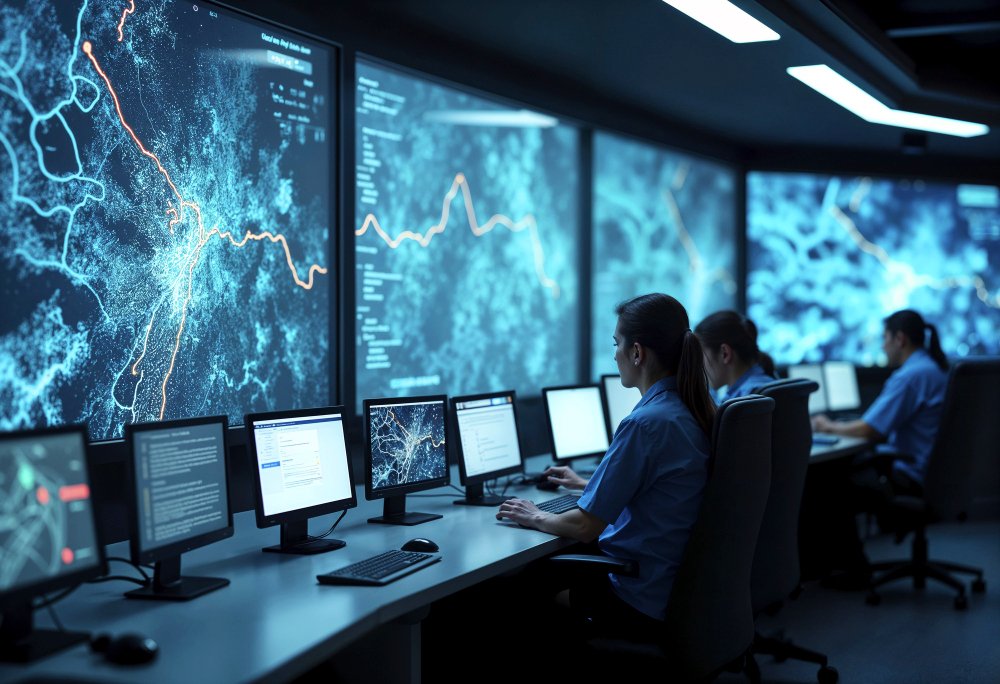
When an emergency response team or security operations center (SOC) monitors a critical situation, a split second and a clear feed make all the difference.
For years, the standard approach in control rooms was simple: tile four, nine, or sixteen commercial LCD screens together into a multi-display grid. While that was better than a single monitor, anyone who has worked in a modern 24/7 command environment knows the glaring flaw: bezels.
Even an ultra-narrow bezel creates black crosshairs directly through maps, facial recognition feeds, and telemetry dashboards. Here is why control rooms across infrastructure, energy, and smart cities are transitioning to seamless Active LED video walls.
The Bezel Problem in Critical Monitoring
In an entertainment setting, your brain can easily ignore a thin seam between screens. In a mission-critical control hub, you cannot.
A thin line across an interactive GIS map or SCADA flow diagram can obscure critical infrastructure lines, hide small telemetry readouts, or cut through a vehicle registration plate on a high-resolution surveillance camera.
Active LED panels fit together with micro-level precision, creating a truly continuous visual canvas. There are zero bezels, zero black seams, and no interrupted data feeds across the entire wall.
Key Requirements for a 24/7 Control Room Wall
Replacing LCDs with LED isn’t just about removing seams; mission-critical operations have distinct technical demands:
- Low Brightness with High Grayscale Performance: Control room operators sit in controlled indoor lighting for eight to twelve-hour shifts. The screen cannot blast blinding light, yet it cannot crush dark shadow details when dimmed down. Advanced fine-pitch LED drivers maintain full grayscale precision even at low brightness levels.
- Reliable Thermal Dissipation: Screens running around the clock generate consistent heat. Heavy-duty die-cast aluminum cabinets double as passive heatsinks, keeping internal electronics cool without noisy fans.
- Hardware Redundancy: A blacked-out screen during a network incident is not an option. Enterprise configurations utilize dual power supplies and backup receiving cards so that if one line drops, the display stays on seamlessly.
- Multi-Window Video Processing: Control rooms ingest dozens of feeds—CCTV, SCADA, live web feeds, and video conferences. Pairing the wall with modular hardware controllers (such as synchronous multi-window processors) allows operators to resize, arrange, and drag-and-drop feeds anywhere on the canvas instantly.
Built for 24/7 Reliability with Aaztec
At Aaztec, our fine-pitch indoor systems (including the Imersiff and ION series) are engineered specifically for mission-critical command centers, security rooms, and traffic monitoring headquarters. We back every project with thorough structural engineering, precision calibration, and dependable local support.
Need to upgrade your operation center’s visual backbone? Connect with our engineering specialists at support@aaztecsolution.com or explore our control room solutions at aaztecsolution.com.